








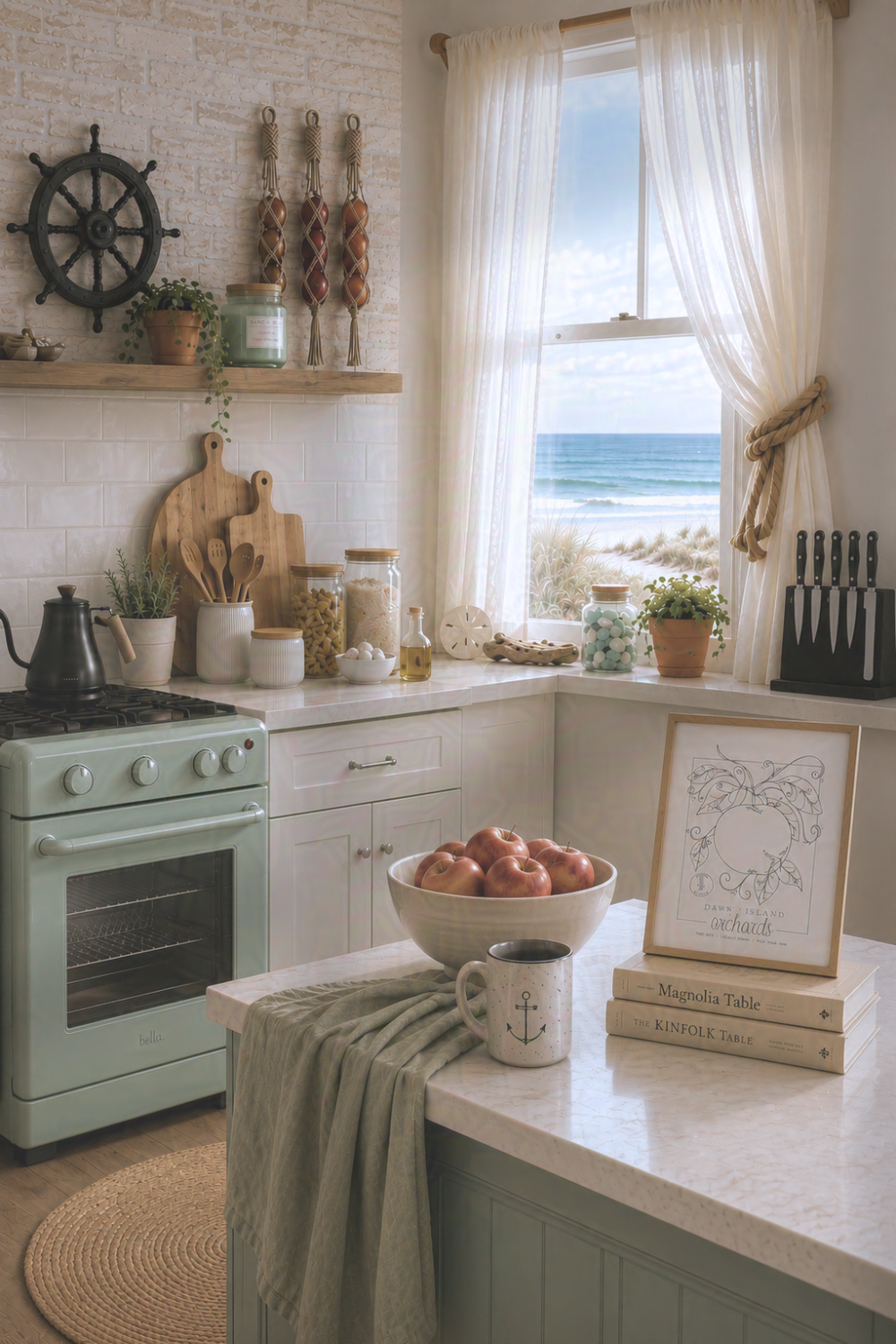
31 Jul How to Create a Kitchen That Tells Your Story
Pinterest has given us no shortage of beautiful cozy kitchens. If you’re like me and spend way too much time browsing pins, you’ve probably seen perfectly labeled spice jars, matching baskets, marble countertops, kitchen organization ideas and pantries that look like tiny boutique grocery stores. I love looking at those spaces.
But somewhere along the way, I realized I wasn’t trying to build a kitchen that looked beautiful in photos. I wanted to build one that invited me to cook—a space I genuinely enjoyed spending time in. Those aren’t always the same thing.
For me, that means finding a balance between beauty and function, with just enough subtle fandom to make the space feel like home.
Kitchens Tell Stories
Every room in our home supports part of our lives. The bedroom supports rest. The studio supports creativity. The closet supports self-expression.
The kitchen is no different. It’s where we nourish ourselves, gather with the people we love, and settle into the little rituals that become part of everyday life. Like every other room, it tells a story about how we live, and we should create a cozy kitchen that tells our story.
One of my favorite fictional kitchens belongs to Sanji from One Piece. It has inspired the way I think about kitchens for years—not because of the ship itself or even the cooking, but because of the intention behind the space. The kitchen wasn’t designed to impress visitors, it was designed to care for the people who gathered there. He doesn’t feed the crew because he’s “the cook.” He feeds them because that’s one of the ways he loves people.
Every tool has a purpose. Every ingredient has a place. Nothing wastes movement because each task naturally flows into the next. The kitchen wasn’t simply efficient, it was welcoming. It was designed to care for the people who gathered there.
How to Create a Kitchen That Tells Your Story
Before you organize a single drawer or buy another basket (guilty!), spend a little time thinking about what you want your kitchen to do for you.
Start with your Kitchen Philosophy
One of the reasons I admire Sanji’s kitchen in One Piece is that it was built around a clear philosophy. Every decision supported the same purpose: feed people well, waste nothing, respect the ingredients, and make the work flow naturally from one task to the next.
That made me stop and think about my own kitchen. My philosophy isn’t exactly the same, but it shares the same heart. I want my kitchen to be a place where people leave feeling cared for. I want to cook with ingredients I enjoy, spend less time searching for tools, and more time actually making food. And then enjoying it. I may not be fighting the World Government, but I do have things to do outside the kitchen.
When your kitchen is built around your own philosophy instead of someone else’s, every organizing decision becomes a little easier. You’re no longer trying to recreate a Pinterest kitchen. You’re creating a space that supports the way you actually live. And that’s the kind of kitchen you’ll want to come back to every day.
What do you want your kitchen to do for you?
Just like we talked about with our closets, don’t design an aspirational kitchen for your aspirational cooking self. Design it for the way you cook right now, in real life.
- Ask yourself these kinds of questions:
- Do you mostly cook weeknight dinners?
- Do you bake every weekend?
- Is tea part of your daily routine?
- Do you meal prep?
- Who else uses the kitchen?
- Who puts things away?
- And perhaps the most important question… who quietly undoes all of your organization?
That last question may seem oddly specific…I live with an actual gremlin who somehow sees every beautifully organized space as a personal challenge. It’s honestly impressive to watch in real time. So if you share your kitchen with someone similar, your organization system needs to work for both of you—not just the version of your home that exists five minutes after you’ve finished tidying it.
Here’s what I’ve learned after a decade of marriage: The best organization system isn’t the prettiest one. It’s the one you can still recognize after a busy Tuesday. If it’s also aesthetically pleasing, that’s a bonus. For you, not your gremlin. Gremlins don’t care about that.
Our kitchens should tell the stories of the people who use them. The foods you love to make, the rituals you return to, and the people you gather around the table all deserve to shape the space. Design around the way you naturally move through your kitchen, and the room will begin to support you instead of asking you to adapt to it.
Get to Know Your Kitchen
You’ll notice we’ve spent more time talking about you than your kitchen. That’s intentional. Your habits shape the space far more than the other way around.
Once you understand what you want your kitchen to do for you, it’s time to take a fresh look at the space itself.
Open every cabinet. Look at your pantry, your drawers, your awkward corners, and the spaces that never seem to work quite right. What could that narrow wall beside the refrigerator become? Is the empty wall above the doorway simply blank space, or is it waiting to support something you use every day?
Before choosing paint colors, wallpaper, baskets, or labels, empty the cabinets first. Wipe everything down and begin with a clean slate. Simply handling each item is often enough to remind you what you use, what you’ve forgotten, and what no longer belongs there.
As you become familiar with your kitchen, you’ll naturally begin to imagine new possibilities. You’ll notice where things interrupt your flow, where you’re taking extra steps, and where a small change could make everyday cooking feel easier. Combine those observations with your philosophy and your daily rituals, and your kitchen will begin to take shape around the life you actually live. It will begin to reflect the story you want to tell.
Keep Your Favorite Tools Within Reach
Your favorite wooden spoon deserves to live where you can reach it.
Don’t display your knives because they’re beautiful. Use them so your cooking experience is more beautiful. Don’t tuck away your favorite tools just because they’re practical. If you use them every day, they deserve to be within easy reach.
Let your Dutch oven sit proudly on the stove. Keep your favorite mug close to the kettle. That slightly bent wooden spoon you’ve had for years? It has earned its place. The vintage tea kettle that makes you smile every morning? Let it become part of the room.
The things you reach for every day already tell the story of your kitchen. Let it look like someone lives and cooks here.
Make Room for Rituals
When someone says your kitchen is having a moment, I hope it’s because you’ve created meaningful moments there.
Before planning the perfect coffee station, think about what your mornings actually feel like. How do you want to feel when you walk into your kitchen to prepare your coffee? Or morning tea. What are those moments that make you come alive in your kitchen? Is it bread baking? Your collection of fresh herbs? Your favorite cookbooks? Do you listen to music while chopping vegetables, or do you prefer to chat with your partner? Does your partner cook with you? Do you open the windows or light a candle while sipping wine? What part of the day feels most like yours?
The tools, gadgets, and beautiful details all help shape your kitchen, but rituals are what make it feel alive. They’re the quiet moments that turn an ordinary room into one that feels like home.
Not everyone has a large kitchen, and that’s okay. There may only be room for a small stool, a cookbook stand, or a pot of fresh herbs on the windowsill. Maybe your ritual is simply putting on your favorite playlist before you start cooking. It doesn’t have to be a grand gesture. The smallest rituals often become the ones we treasure most.
Let Your Kitchen Tell Your Story
Every kitchen tells a story. The question is whether it’s telling yours’. It’s not about displaying the prettiest jars or buying the latest decor. It’s about creating a place where you genuinely want to cook, gather, and return to each day. This looks different for every person, every couple, every family:
- A stack of well-loved cookbooks
- Recipe cards with handwritten notes
- Fruit paintings that make you smile
- Family recipes passed from one generation to the next
- A favorite mug from a convention
- A tea towel from a memorable trip
- A tiny figurine tucked onto a shelf
- Whatever quietly tells your story
When someone walks into your kitchen, they don’t need to know every story behind these things. They simply need to feel that someone lives here—and loves being here.
Leave Room to Grow
(…Or let it cook, as the kids are saying.)
You don’t have to finish your kitchen in one weekend. Leave room for the favorite mug you haven’t found yet, the cookbook full of sticky notes and bookmarks from constant use, the herbs you’ve been meaning to grow, or the artwork that one day makes you stop and think, “That’s exactly where it belongs.”
The most memorable kitchens aren’t the ones that look perfect. They’re the ones that invite us back, day after day, to cook, gather, and just be. They are the rooms that exist to nourish not just our bodies, but our souls. They hold our routines and our relationships, all while creating space for the stories we’re still writing together.
Long after the dishes are washed and the counters are cleared, the moments we create in our kitchens stay with us. A favorite recipe. A quiet cup of tea. A conversation that lasts longer than dinner. Those are the things that truly shape a home. And perhaps, in their own quiet way, they’re part of the stories we’re choosing to live.

No Comments